


10 Things Procurement Managers Should Check Before Buying Safety Shoes in Bulk

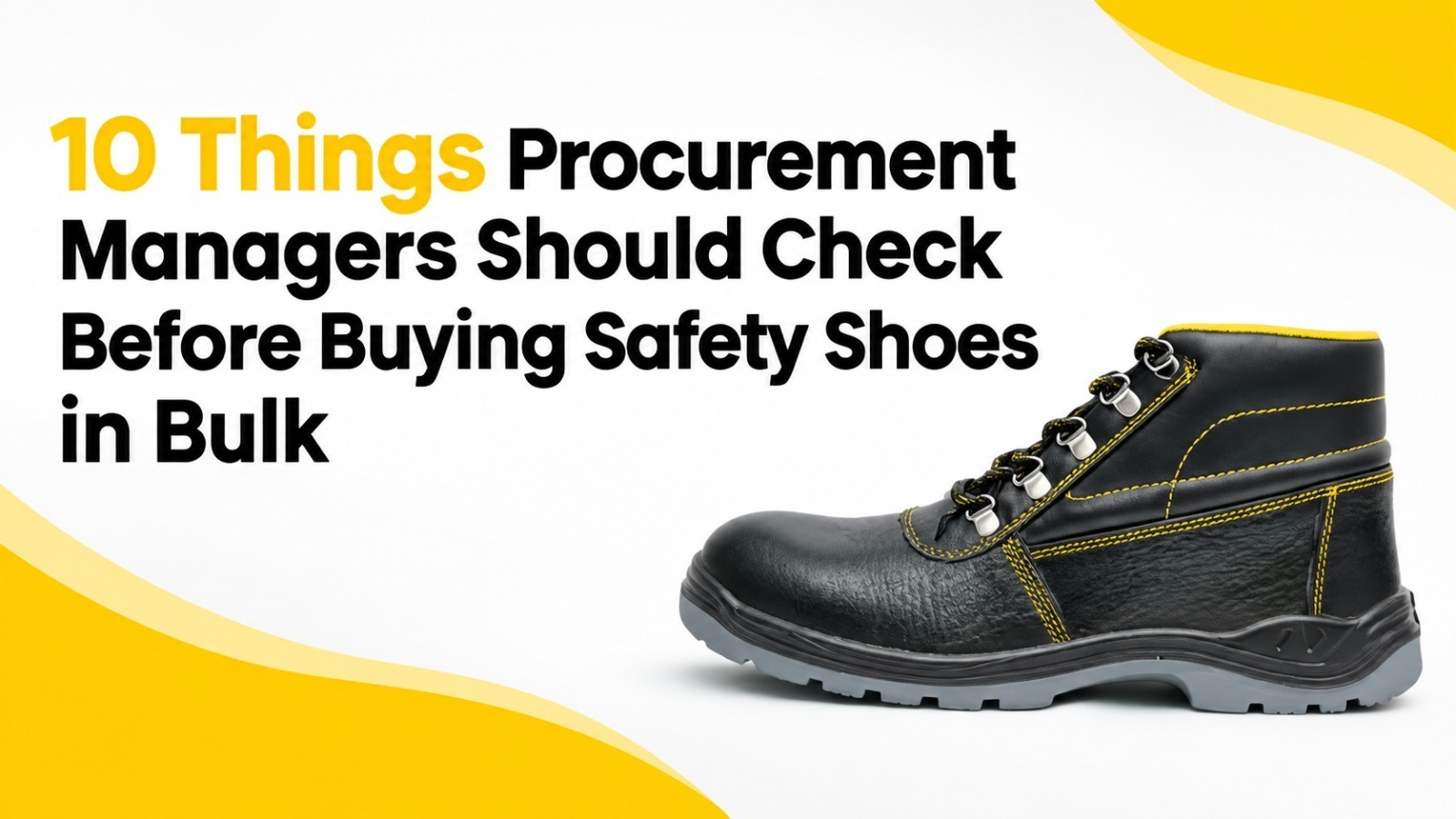
Buying safety shoes in bulk is not simply about finding the lowest price per pair. For factories, construction companies, warehouses, manufacturing units, mining operations, oil & gas facilities and other industrial workplaces, the right safety footwear must provide reliable protection, comfort, durability and consistent quality across the entire workforce.
A bulk safety shoe purchase can involve hundreds or thousands of pairs. A mistake in product selection can lead to poor worker acceptance, premature replacement, inconsistent sizing, safety risks and higher overall procurement costs.
That is why procurement managers should evaluate more than price before finalizing a supplier.
From safety standards and toe protection to sole performance, sizing, durability and supplier reliability, here are 10 important things to check before placing a bulk order for industrial safety shoes.
1. Check the Applicable Safety Standards and Certifications
The first and most important step is to verify whether the safety shoes meet the applicable standards for your industry and workplace.
For industrial safety footwear in India, IS 15298 is an important standard series. BIS currently lists IS 15298 (Part 2): 2024 – Personal Protective Equipment – Part 2: Safety Footwear under its product certification framework.
Before purchasing, procurement teams should ask the manufacturer or supplier for relevant certification and testing documentation.
What to verify:
- Applicable IS standard
- BIS certification/licence details where applicable
- Product test reports
- Model and certification correspondence
- Applicable safety features
- Batch/product documentation
- Manufacturer details
Do not rely only on statements such as “ISI quality” or “industrial grade.” Ask for supporting documentation.
Procurement Tip:
Always ensure that the certification/documentation relates to the actual safety shoe model being purchased, rather than a different model from the same supplier.
2. Identify the Workplace Hazards Before Selecting the Shoe
There is no single safety shoe that is ideal for every industrial environment.
The correct footwear depends on the hazards workers face.
For example:
- Construction sites may involve falling objects, uneven surfaces and sharp materials.
- Manufacturing plants may involve oil, machinery, metal components and heavy materials.
- Warehouses may require protection against impact, slips and long hours of walking.
- Mining environments can involve demanding terrain and heavy-duty working conditions.
- Oil and industrial environments may require specific resistance and grip characteristics.
- Engineering workshops may expose workers to metal parts, tools and other workplace hazards.
Before requesting quotations, procurement managers should work with the EHS/Safety team to identify the actual risks.
Ask:
What hazards are we protecting workers against?
Once the hazards are identified, the appropriate safety shoe specifications can be selected.
3. Evaluate Toe Protection Carefully
Toe protection is one of the most important features of industrial safety footwear.
Depending on the application, businesses may consider:
- Steel toe safety shoes
- Composite toe safety shoes
- Other approved protective toe-cap configurations
A quality safety shoe should provide appropriate protection against workplace impact and compression hazards according to the applicable specification.
BIS documentation for IS 15298 safety footwear includes requirements and testing related to toe protection, along with other footwear performance characteristics.
Procurement checklist:
- What type of toe protection is used?
- Is it suitable for the workplace hazard?
- Is the toe protection tested?
- Does the product documentation support the claimed specification?
- Does the toe area provide sufficient space for workers’ feet?
Important: Don’t select a toe-cap specification simply because it is popular. Match it to the actual risk assessment.
4. Check Sole Quality, Grip and Slip Resistance
The sole is critical because workers may spend 8–12 hours a day walking or standing on industrial surfaces.
A safety shoe with a poor-quality sole can affect:
- Grip
- Stability
- Walking comfort
- Durability
- Slip resistance
- Overall worker safety
BIS product documentation for safety footwear includes testing related to sole performance and other footwear characteristics.
Procurement managers should evaluate the sole based on the working environment.
Consider:
- Slip resistance
- Oil resistance where required
- Abrasion resistance
- Flexibility
- Grip on the expected floor surface
- Durability under daily industrial use
For workplaces where workers encounter oil, water, dust or other contaminants, sole selection becomes even more important.
5. Don’t Ignore Comfort and Fit
Safety footwear protects workers—but if the shoes are uncomfortable, employees may avoid wearing them correctly.
This is one of the most overlooked factors in bulk procurement.
Workers may wear safety shoes for an entire shift, so procurement teams should consider:
- Correct sizing
- Foot shape
- Weight of the shoe
- Cushioning
- Insole quality
- Breathability
- Ankle support
- Flexibility
- Internal comfort
Why does comfort matter?
Poorly fitting footwear can cause discomfort and worker dissatisfaction. This can negatively affect safety compliance and employee acceptance.
Best practice for bulk orders:
Before placing a large purchase order, request samples in multiple sizes and conduct a trial with actual workers.
Collect feedback from:
- Machine operators
- Site workers
- Warehouse staff
- Supervisors
- Maintenance teams
The people who wear the shoes every day are often the best source of practical feedback.
6. Check Material and Construction Quality
Two safety shoes may look almost identical but perform very differently in real working conditions.
Procurement managers should examine the construction of the footwear instead of judging only its appearance.
Check:
- Upper material
- Stitching quality
- Toe-cap integration
- Sole attachment
- Heel construction
- Insole
- Lining
- Eyelets
- Laces
- Overall finishing
The quality of raw materials and construction has a direct impact on durability and worker experience.
BIS documentation for IS 15298 also specifies requirements relating to footwear materials and performance testing.
Procurement Tip:
Ask for product samples and physically inspect them before approving a large order.
7. Compare Durability, Not Just Purchase Price
One of the biggest procurement mistakes is choosing the cheapest safety shoe.
A lower price per pair does not automatically mean lower total cost.
Suppose:
- Supplier A offers a shoe at ₹900 per pair.
- Supplier B offers a shoe at ₹1,200 per pair.
If Supplier A’s footwear needs to be replaced significantly more often, the cheaper product may actually cost more over time.
Consider Total Cost of Ownership (TCO)
Evaluate:
Purchase Price + Replacement Cost + Maintenance/Replacement Frequency + Logistics + Worker Acceptance + Potential Quality Issues
This gives procurement teams a much more realistic comparison.
The goal should be:
Best value for money—not simply the lowest price.
8. Verify Size Availability and Bulk Supply Capability
Imagine ordering 1,000 pairs and discovering that several commonly required sizes are unavailable.
This can create unnecessary delays and additional procurement work.
Before finalizing a supplier, confirm:
- Available size range
- Size-wise quantity capability
- Stock availability
- Production capacity
- Lead time
- Repeat-order availability
- Packaging
- Delivery schedule
For large organizations, standardization matters.
If employees across multiple locations use the same approved footwear model, procurement becomes easier.
It can also simplify:
- Inventory management
- Replacement orders
- Vendor management
- Safety audits
- Product standardization
9. Evaluate the Supplier’s Reliability and After-Sales Support
A good safety shoe is important—but a reliable supplier is equally important for bulk procurement.
Before signing a purchase order, evaluate the supplier’s ability to support your organization over the long term.
Ask the supplier:
- How long have you been manufacturing/supplying safety footwear?
- Can you provide consistent quality across large orders?
- What is the standard delivery lead time?
- Can you handle repeat orders?
- Do you support bulk and institutional requirements?
- Can you provide samples?
- How are quality complaints handled?
- Is customization or branding available?
- Can you support multiple locations?
For businesses purchasing safety shoes regularly, supplier consistency can be more valuable than a one-time discount.
10. Request Samples and Conduct a Real-World Trial Before Bulk Purchase
This is perhaps the most practical step in the entire procurement process.
Never finalize a large safety shoe order based only on:
- Product photographs
- Catalogue specifications
- Price quotations
- Online descriptions
Request samples and test them in the actual workplace.
Conduct a trial covering:
Safety:
Does the shoe provide the required protection?
Comfort:
Can workers wear it comfortably throughout their shift?
Grip:
Does the outsole perform well on the actual workplace surface?
Durability:
Does the shoe withstand normal working conditions?
Fit:
Are the sizes appropriate for the workforce?
Worker feedback:
Are employees comfortable using the footwear?
After the trial, gather feedback from the safety team, procurement team, supervisors and workers before approving the final bulk order.
Bonus: Bulk Safety Shoe Procurement Checklist
Before issuing your purchase order, use this quick checklist:
| Procurement Factor | What to Check |
| Safety Standard | Applicable IS/BIS requirements |
| Certification | Valid documentation for the actual model |
| Workplace Hazard | Impact, puncture, slip and other risks |
| Toe Protection | Appropriate toe-cap specification |
| Sole | Grip, slip resistance, durability and application suitability |
| Comfort | Fit, cushioning, weight and breathability |
| Material | Upper, lining, sole and construction quality |
| Durability | Expected service life and working conditions |
| Sizes | Required size range and availability |
| Bulk Capacity | Production and stock capability |
| Delivery | Lead time and logistics |
| Supplier | Experience and reliability |
| Samples | Pre-order testing |
| Worker Feedback | Actual user acceptance |
| Total Cost | Long-term value, not just unit price |
Why Businesses Should Standardize Safety Footwear
For organizations with large workforces, standardizing safety footwear can make procurement and safety management more efficient.
A standardized product range can help businesses achieve:
- Consistent safety specifications
- Simplified procurement
- Easier inventory management
- Faster repeat ordering
- Consistent employee PPE
- Better supplier management
- Easier quality control
- Improved workplace safety processes
For companies operating across multiple sites, standardization can be particularly useful when the same footwear specifications are required across locations.
Choose the Right Safety Shoes for Your Industry
Whether you operate a manufacturing plant, construction project, warehouse, engineering facility, mining operation, logistics business or industrial unit, safety footwear should be selected based on workplace hazards, applicable standards, comfort, durability and supplier reliability.
At Leather Craft, we provide industrial safety footwear solutions for businesses and institutional requirements, with options suitable for different industrial applications and bulk procurement needs.
Our range is designed for organizations looking for dependable safety footwear with a focus on protection, durability, comfort and consistent supply.
If your organization is planning a bulk purchase, discuss your workplace requirements with the supplier before finalizing the product.
Looking for Safety Shoes in Bulk?
Choose safety footwear based on protection—not just price.
For bulk orders, corporate requirements, industrial safety footwear, OEM requirements or customized business enquiries, connect with Leather Craft to discuss your requirements.
Request a Bulk Safety Shoe Quote Today
Website: https://lcshoes.in/
Frequently Asked Questions (FAQs)
1. What should procurement managers consider when buying safety shoes in bulk?
Procurement managers should consider safety standards, workplace hazards, toe protection, sole performance, comfort, durability, size availability, supplier capacity, delivery timelines and total cost of ownership.
2. Which standard is important for industrial safety footwear in India?
IS 15298 is an important Indian Standard series for personal protective footwear. BIS currently lists IS 15298 (Part 2): 2024 – Safety Footwear within its certification framework.
3. Should companies test safety shoes before placing a bulk order?
Yes. A sample trial with actual workers can help evaluate fit, comfort, grip, durability and suitability for the workplace before committing to a large quantity.
4. Is the cheapest safety shoe the best option for bulk procurement?
Not necessarily. Procurement teams should compare total cost of ownership, expected durability, worker acceptance, replacement frequency and product quality rather than focusing only on the initial price.
5. What industries commonly require industrial safety shoes?
Safety footwear is commonly used in construction, manufacturing, engineering, mining, warehouses, logistics, oil & gas, infrastructure and other industrial environments where workers may face workplace hazards.
6. Can businesses order safety shoes in bulk?
Yes. Businesses can purchase safety footwear in bulk for employees, contractors, industrial projects, distributors and institutional requirements. For large orders, buyers should confirm product availability, sizes, production capacity and delivery timelines with the supplier.
Final Takeaway
Buying safety shoes in bulk is a workplace safety decision as much as it is a procurement decision.
The right footwear should meet applicable standards, address workplace hazards, provide appropriate protection, remain comfortable throughout long shifts and deliver reliable performance over time.
Before placing your next bulk order, remember these 10 points:
Standards → Hazards → Toe Protection → Sole → Comfort → Materials → Durability → Sizes → Supplier → Trial
A well-planned procurement process can help your organization improve worker protection while reducing unnecessary replacement and procurement costs.
Choose the right safety footwear. Protect your workforce. Procure with confidence.

